
Brasso roast stew (healthy version)
How to prepare it in a healthy, diet-friendly way
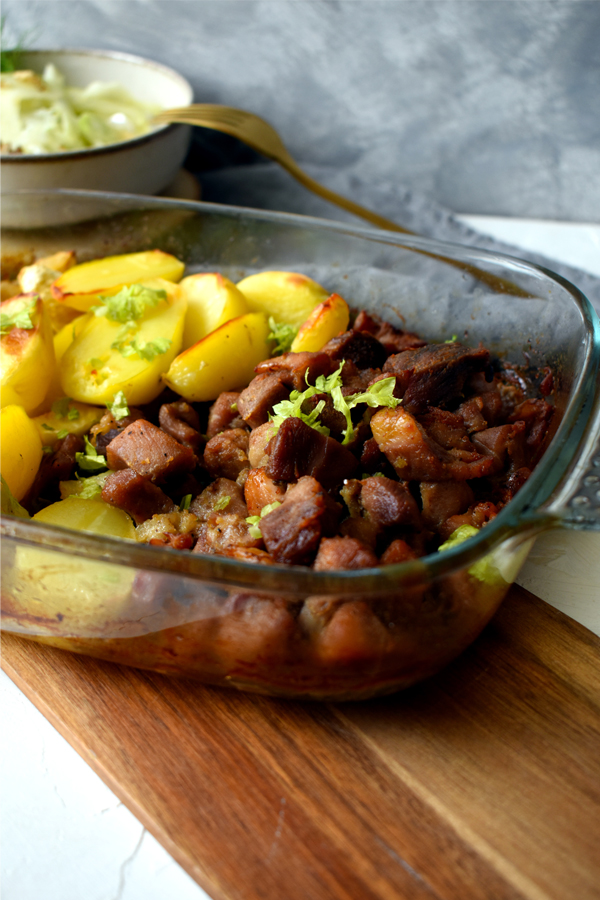
Brasso roast stew can be prepared in several ways. I will show you what you need to make a lower-fat but still delicious dish.
The origin of Brasso roast stew
The name of the recipe somehow tempts you to look into its origins. I couldn’t find any juicy stories, only this on Wikipedia:
According to the most likely theory, the recipe for Brassó aprópecsenye was invented by Count Nándor, a railway chef, in 1948, on the Budapest-Brassó route (with pork, garlic, black pepper, and potato ingredients).
One thing is certain: this is a Hungarian recipe.
What kind of meat is used to make Brasso roast stew?
Old recipe books say all sorts of things. You have to be on your toes to make sense of these outdated pages. They mention beef shank and sirloin. New cookbooks feature tenderloin, which is what we learned in culinary school. This is a more expensive ingredient. If you can’t afford it, shoulder is also suitable. However, if you really want to make it diet-friendly, pork tenderloin or chicken breast are your ingredients of choice.
How can it be diet-friendly?
People on diets often make the mistake of getting their protein from only one source: chicken breast. The advantage of this is that chicken breast is very low in fat. Pork generally contains much more fat, but there are some cuts that are still quite good in terms of fat content.
100 g of pork tenderloin and 100 g of chicken breast contain the same amount of calories (120). 100 g of pork shoulder contains 2.7 times more fat than 100 g of chicken breast. So, if I had to choose one of these three types of meat for a healthy, diet-friendly meal, I would choose chicken breast. This can also be used to make a delicious Brasso roast stew. However, it is worth eating as many different types of meat as possible to provide our bodies with a variety of nutrients. Pork has a better amino acid composition than chicken breast and a different mineral content, for example, it is rich in iron. It is worth adding pork to our diet for variety, and when it comes to a traditional recipe such as Brasso roast stew, I think we can safely choose pork tenderloin if our wallet allows it. Pork tenderloin has the same number of calories as chicken breast, but it has more protein than pork shoulder and less fat than pork shoulder.
So, to the question of how Brasso roast stew can be diet-friendly, I have four answers:
- Prepare it with pork tenderloin (or chicken breast).
- Leave out the bacon (use olive oil for frying).
- By marinating it in oil and then baking it in the oven, you can use less fat than if you were to fry it in oil.
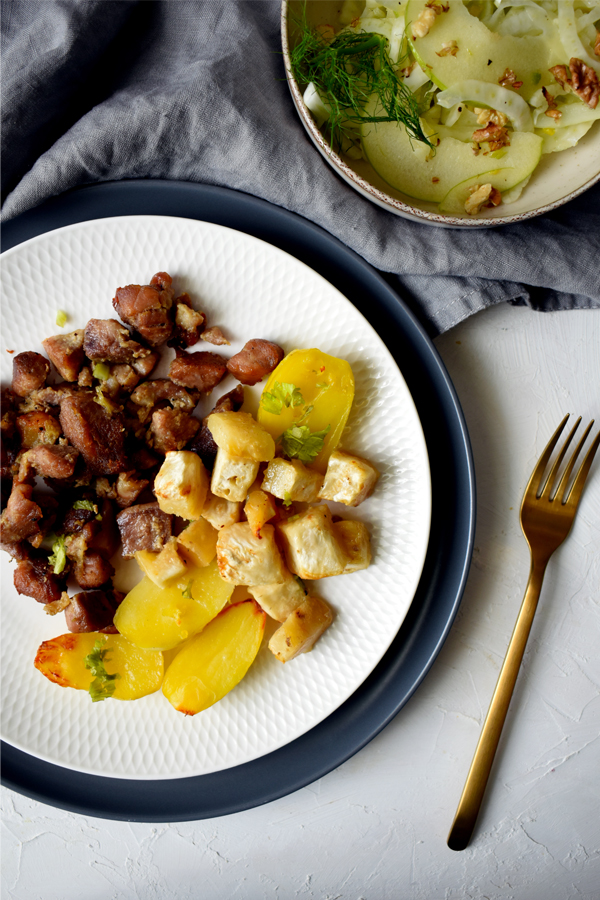
- Potatoes have a high glycemic index and are not a diet-friendly side dish, so replace them with celery, or if you don’t want to leave them out completely, replace at least half of them with celery.
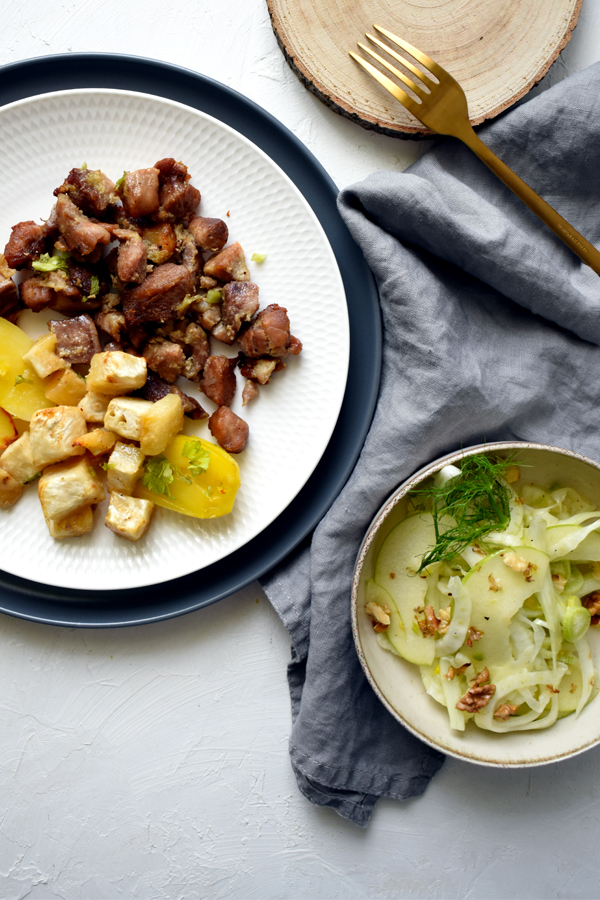
Tip: Try it with this fennel salad!
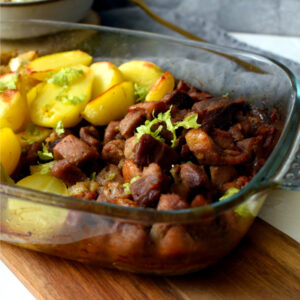
Brasso roast stew
Ingredients
- 500 g pork tenderloin
- salt
- freshly ground black pepper
- 1 tablespoon olive oil
- 50 ml water
- 4 smaller potatoes
- ½ celery root
- 4 cloves garlic
Instructions
- Clean and dice the meat.
- Place in a heatproof dish. Season with salt, pepper, and 2 cloves of crushed garlic, then drizzle with olive oil. Mix thoroughly. Leave to marinate in the refrigerator for 1-2 hours.
- Before baking, pour a little water over it and cover with aluminum foil. Place in an oven preheated to 200°C (392°F).
- After 30 minutes, add the peeled and diced potatoes and celery, as well as the remaining garlic cloves, whole.
- Continue baking for 15 minutes, then remove the foil and stir.
- Bake for another 15 minutes without aluminum foil.
Calories and macros
Did you like it? There’s more where that came from. 🙂 Sign up for my newsletter!