Which Diet is Right for You?
Diets and healthy eating trends – Find the one that’s right for you!

Diets and healthy eating trends come and go. I follow them with a professional eye. Lately, I’ve been scratching my head more and more when one trend presents convincing research on the benefits of a meat-free lifestyle, while another proves the health benefits of meat consumption with equal determination. So, should I eat meat or not? Who should I listen to? Should I give up milk and choose plant-based milk instead? Should I be vegan, or is the ketogenic diet more suitable for me? If you also can’t find your way out of this dark maze, then stick with me! I have gathered some information that may help you see through these issues. After that, it’s up to you to make a wise choice.
Diets and nutritional trends
In the early 2000s, when I wanted to lose a few pounds (and, of course, dreamt of having a flat stomach like Britney Spears, like all my classmates at the time), I came across diets such as the American diet, the 90-day diet, and the Atkins method. Then, in 2014, I decided to lose weight again, but by then the range of diets had expanded considerably: bodybuilding diets, paleo diets, 160-gram carbohydrate diets, vegetarian lifestyles, and gluten- and lactose-free trends had all come into view.
I believe that from 2020 onwards, we will no longer be talking about fad diets, but rather complete nutritional systems, special dietary principles, and disease-specific diets. It’s like back in school: there were rockers, punks, dancers, and rappers – and today there are vegans, vegetarians, paleo believers, keto dieters, Mediterranean diet followers, and flexitarians. Plus gluten- and lactose-free dieters – and many others. I’m deliberately not listing everything, because I’ve done that in a table instead.
In the table below, I have compiled a list of diets that are scientifically proven to promise weight loss in a more or less healthy way. That’s why I left out the cabbage soup diet, the egg diet, and various “miracle powders” or shakes that promise quick but unsustainable results. Even so, I’m sure I’ve left out a few trends – to be honest, I stopped at 20 because I was shocked that there were so many different options.
Categories
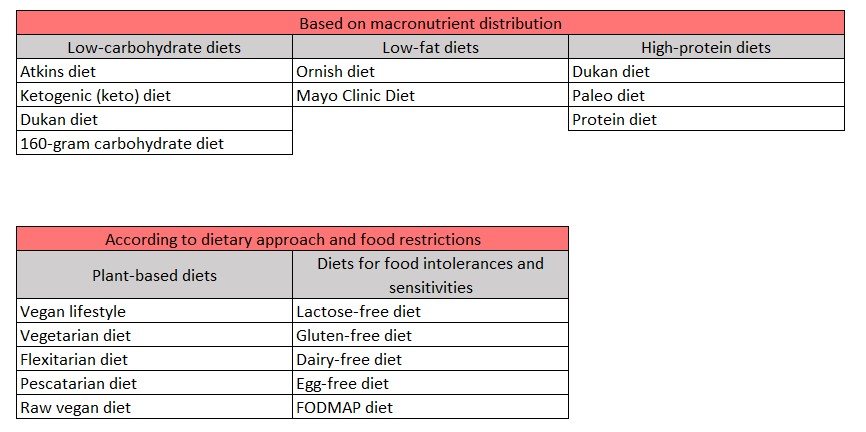
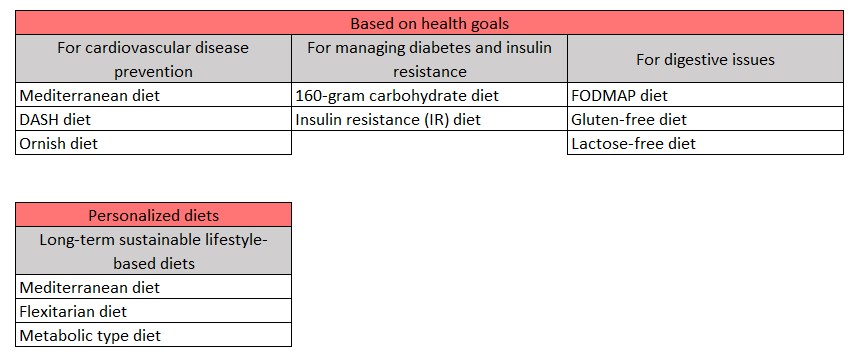
Based on macronutrient distribution, I found nine different trends, depending on whether they restrict carbohydrates, protein, or fat.
I created two large groups based on nutritional approach and food restrictions. One is plant-based diets, and the other is diets based on food intolerances and sensitivities. I listed five types of plant-based diets, but in a looser classification, the Mediterranean diet could also be included here, because although meat and fish can be consumed, the proportions are skewed towards plant-based foods. I also collected five types of food intolerance diets – these are the better known ones, but there are obviously more.
I could have also grouped them according to which trends we can freely choose based on our convictions – such as the vegetarian diet – and which ones we must choose because of a sensitivity or illness. Examples of the latter are the gluten-free diet and the IR diet.
In addition to these, I could have categorized them based on goals. For example, healthy eating or weight loss – and within that, rapid or sustained weight loss.
The main question
We want to live healthy, slim, and energetic lives – but with so many nutritional trends and diets out there, why are so many people still struggling with excess weight and health problems? Weight loss is now a huge industry: miracle pills, crash diets, and ever-changing trends attempt to treat weight problems, but why can’t they solve them?
Our ancient programming vs. the challenges of the modern world
Humans are fundamentally designed to be slightly overweight because, during evolution, those who had reserves for times of scarcity had a better chance of survival. Nowadays, it is rare for us to go without food for days or weeks, but this is still encoded in our genes:
“Eat as much as you can and exercise only enough to conserve your energy reserves.”
So our ancient genes are still there, even though we no longer need to hunt and gather. All we have to do is open the refrigerator. Our genetics predispose us to be overweight, but whether we become fat or slim depends on our lifestyle.
In today’s world, it is not just the abundance of food in the refrigerator that is to blame for obesity. Stress, a sedentary lifestyle, and the consumption of ultra-processed foods are also part of modern life – and all have a serious impact on our health.
The COVID-19 pandemic has affected not only our daily lives, but also our eating habits. Constant stress – are we vaccinated? What will happen after quarantine? How do we cope with the loss of a loved one? – has played a significant role in many people turning to food for comfort. This stress is still with us today. Although the pandemic no longer dominates the news, it is still present, and the global political situation – wars, economic uncertainty, domestic political tensions in the US – is causing further concern. So the question is not only what we eat, but also how we deal with the constant tension that permeates our lives. Nowadays, many people may rightly ask themselves the depressing question: will we have anything to eat in the coming years? Should we diet or rather stock up while we still can?
The secret of obesity
Dr. Jason Fung writes in his book The Obesity Code that obesity is a complex problem that can be influenced by many factors, including excessive sugar consumption, chronic sleep deprivation, high stress levels, a sedentary lifestyle, various diseases, and many other factors. The problem is that most diets focus on only one factor, while the real solution is much more complex.
“Obesity is nothing more than a hormonal disorder that regulates fat storage. Insulin is the main hormone that triggers weight gain, so the logical solution is to reduce insulin levels.” There are several ways to do this: for example, eliminating white sugar and white flour is the basis of many diets, but there are many other approaches that can be effective. Which one should you choose?
A whirlwind of diets
Over the years, I have studied and tried many diets. There were fasting diets, diets where you could only eat very few carbohydrates, and diets where you had to consume a lot of protein. I also tried a vegetarian diet for six months. I also considered a vegan lifestyle after watching a miniseries about it on Netflix. In the end, however, it turned out that the show was sponsored by a company that manufactures vegan products. This made me wonder: would the series have been the same if it had been sponsored by a company that sells meat or dairy products? This only reinforced my belief in the importance of critical thinking when it comes to diets and various healthy eating trends.
Gather information, but don’t believe everything – be suspicious if something is heavily advertised. Think carefully, weigh up the options, and only then decide what is best for you!
Know what’s good for you!
I stopped trying diets after a short time because I realized that the food I was eating did not make me happy. I felt depressed and moody for days. This was solely due to the boring flavors. I found that diet foods weren’t flavorful enough and didn’t give me the enjoyment I always look for in food. Almost every weight loss theory says that it’s not important to enjoy flavors, only to lose weight. I can’t agree with that. It is important to me, maybe even the most important thing.
If your diet includes tasty, delicious foods, you won’t give up after a week. That’s why you’ll find delicious diet recipes on my website.
While one camp opposes excessive protein consumption, the other camp considers it appropriate. While one camp rejects excessive carbohydrate consumption, the other camp considers it optimal. One camp does not consume fruit, while the other considers fruit to be a staple food. One prohibits the consumption of dairy products, while the other considers them necessary.
I could list many more differences between the various diets, but even from this, it is clear how easy it is to get lost in them. After a while, you are no longer sure of anything, because it may well be that if you follow a weight loss method, it will soon turn out to be unhealthy, or at least harmful to your health.
From all this, I have come to the conclusion that we must listen to the signals from our own bodies. We have to find out for ourselves what is good for us.

My own method
I had to realize that there is no diet that suits everyone. Every person is different, so we need different diets.
I don’t want to judge any diet. Everyone is different. Some people can easily give up dairy products, for example, while others don’t like to eat too much meat, and still others eat meat with meat. Everyone has to find their own diet. If a bodybuilding diet works for you, go for it. If you swear by paleo, go ahead, because it may be ideal for you.
The problem was that none of these diets worked for me. I took what I liked from each of them, but I wanted to develop it according to my own taste buds. I wanted to diet in a varied, tasty, healthy, and happy way, and I succeeded.
This became the “Eat and Lose Weight” method, with which I lost 10 kilos and have maintained my weight for years. It worked for me. It may not work for you. However, I definitely recommend a lifestyle change instead of a diet. A real lifestyle change takes into account not just one aspect, but all the factors that ensure long-term health and balance.
A healthy lifestyle is key
I lost the extra pounds that were bothering me with the Eat and Lose Weight method. Later, I realized that a healthy lifestyle is about more than just what’s on my plate. It’s not enough to eat well; you also have to do things right in other areas of your life. Weight gain occurs when you lose your balance. Balance can be upset in other areas as well.
Diet is just a tool – a healthy lifestyle is the goal! Start consciously! I have compiled the basics of a healthy lifestyle, or rather, the 7 most important pillars for me. You can read about them here: >> How to Maintain a Healthy Lifestyle? – 7 Pillars
One final thought
My goal remains a healthy lifestyle. My website is about this, and my recipes support it. I stand by this. However, I cannot be so blind as to not see that I cannot control everything. I cannot control all the factors that affect my health. I can buy organic vegetables and farm-fresh food. I can follow all the dietary rules. But everything will never be perfect.
For example, I cannot influence the smoggy air in big city. I cannot completely eliminate stress from my life. I cannot influence which mutant virus will knock me out for a week. There will always be factors beyond my control. And what’s most annoying is that the more I live in an uncertain world, the more I want to control areas of my life. And when I think that at least I can control my diet, I am very much mistaken, because I can’t really control anything.
It’s better to let go and switch to flexible thinking. I do what I can, eat what I want, and don’t restrict myself to my own rules – especially not rules made up by others. I’ve had enough of people telling me what to do and instant Instagram advice! I know what’s good for me, and I do what I can to achieve it – while realizing that there is no perfect solution.
Summary
Despite the wide variety of diets and healthy eating trends, obesity and lifestyle diseases continue to be widespread. This is because obesity and health problems are caused by a combination of factors – for example, excessive sugar consumption, a sedentary lifestyle, stress, or hormonal imbalance can all contribute.
However, most diets focus on only one aspect of the problem and are therefore unable to provide a complete solution on their own. Real change does not come from following yet another fad diet, but from developing a comprehensive, personalized lifestyle that takes into account individual needs and all factors that affect health. And it handles all of these factors flexibly.
When choosing between diets and nutritional trends, it is worth clarifying your own goals first. Is healthy eating the main consideration? Are you trying to lose weight? Do you need a special diet due to an illness? Or do you want to avoid eating meat for ethical reasons? Define your goal and find the best solution for you. Do your research thoroughly and think critically! Browse through the trends, try out several different ones, and listen to your body’s signals! Based on all this, create the diet that best suits your lifestyle and never forget to stay flexible!
Photos: Pixabay